Chapter 3. Why Learn This?
Optional Read this when you need it. You can skip it and still follow the later chapters.In short: Even with the same AI, your results change dramatically depending on how you ask. Anyone can close that gap with a little practice.
Same Tool, Different Results
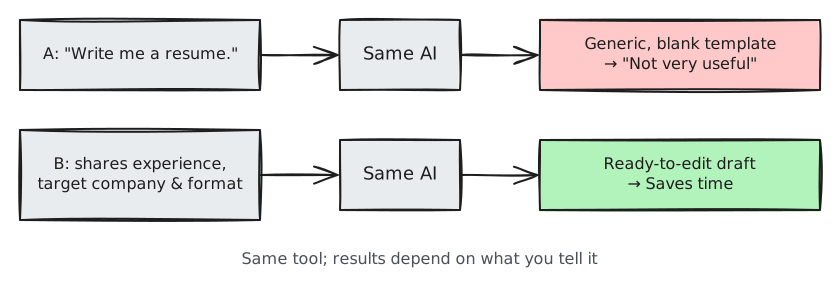
Imagine two people asking the exact same AI for help with their resume.
Person A's request
Write me a resume.The AI does not know who Person A is. So it gives back a generic template with blank spaces for their name and work history. Person A thinks, "This is useless," and closes the window.
Person B's request
I managed inventory at a logistics company for 5 years, and now I'm applying for the operations team at an online shopping (e-commerce) company.
Based on my work notes below, write a 3-line "Career Summary" for my resume
that highlights experience useful for e-commerce operations.

[Work Notes]
- Managed weekly inventory data for 3 warehouses in Excel
- Improved the return process and shortened turnaround time
- Trained 4 new hires
Person B gets sentences they can use right away. Then they follow up by asking the AI to tweak the parts they don't like.
The difference between the two wasn't the AI—it was the request. Person A shared nothing, while Person B shared their background, target role, and desired format. This request text is called a prompt. You will learn how to write good prompts starting in Chapter 4.
Quick check
Person A just told the AI, "Write my resume," while Person B shared career notes, the target company, and the desired format. It was the same AI, so why were the results different?
How You Can Use It Every Day
This tool is not just for developers or experts. Below are examples anyone can use right away.
| Situation | Try asking like this |
|---|---|
| Work | "Rewrite this email so it's polite but firm, and says we can't delay the schedule." |
| Contracts & documents | "Find any clauses in this lease agreement that could be unfair to the tenant, and explain them in plain language." |
| Study | "Explain step by step why the quadratic formula works, at a middle school level." |
| Daily life | "I have eggs, tofu, green onions, and kimchi in my fridge. Give me 3 dinner ideas I can make in 20 minutes." |
| Travel | "Plan a 3-day, 2-night trip to Busan with my parents that doesn't require much walking." |
| Parenting | "My 7-year-old asked 'Why does it rain?' Show me how to explain it at a child's level." |
When you paste in a contract or an email, first delete names, addresses, phone numbers, and bank account numbers, or cover them with "OOO." That's because what you type may be stored by the service. Chapter 9, "Using AI Safely" covers what you should never put in.
Quick check
Someone asked the AI, "I have eggs, tofu, green onions, and kimchi in my fridge. Give me 3 dinner ideas I can make in 20 minutes." Why did this request work so well?
What Changes When You Learn
- You save time. Tasks that used to take a long time to start—like writing a first draft or organizing notes—can be done in minutes.
- You get better results. Because the answer fits your situation, you spend less time fixing it.
- You get fooled less often. When you know how AI makes mistakes, you know what to double-check.
- You can move to the next level. By the end of this guide, you will even build something yourself with AI. Learning how to ask well is the starting point.
Quick check
People say learning how to use AI makes you "less likely to be fooled" by its wrong answers. Why is that?
Clearing Up Common Myths
- "AI figures everything out on its own" — It doesn't. You need to tell it your situation and goal for it to do a good job.
- "You have to memorize complicated commands" — There are no magic spells. Just organize your thoughts clearly, the way you would when asking a coworker for help.
- "If the first answer is bad, it's useless" — It doesn't need to be perfect on the first try. Continuing the conversation and asking for changes is the normal way to use it.
- "AI answers are always accurate" — As you saw in Chapter 1, it can be wrong. Always verify important details.
Quick check
Which statement about AI is a fact rather than a myth?
Watch and Learn More
All videos below are in English. You can turn on subtitles in your language by clicking the YouTube Settings (gear icon) → Subtitles/CC → Auto-translate. Videos play right inside this page.
How I use LLMs · Andrej Karpathy · Great if you want to see how an expert actually uses AI like ChatGPT in daily life and work (long video)
Try It Yourself
Type both Person A's request and Person B's request into an AI yourself. Feel free to replace Person B's work notes with your own real experience. Put the two answers side by side and compare them. Which one can you use right away without much editing? Which one actually includes your experience?
Key Takeaways
- Most differences in results come from your request (prompt), not the AI.
- You can use it right away for work, paperwork, studying, or daily life.
- Instead of expecting a perfect answer on the first try, refine it through follow-up conversation.
Glossary
| Term | One-line meaning |
|---|---|
| Prompt | The request you send to AI |
| E-commerce | Selling goods over the internet, as an online store does |
Finished this chapter?
Progress is saved only in this browser. See your progress on the full table of contents.
Next chapter: Chapter 4. Prompt Basics